A Text Comprehension Routine for ELLs


For students with minimal exposure to English, approaching texts in English is extremely daunting. And yet, our emergent bilingual learners have so much to gain from reading authentic texts in English. They will gain exposure and comfort with the variability of English phonics. They will learn to recognize cognates and the differences between English and Spanish grammar (conjugation, subject/verb agreement and word order). They will build knowledge and learn English idioms. Providing students with rigorous texts right from the get-go allows them to assimilate all these aspects of language, while also improving their English pronunciation while reading aloud. So how do you get them reading?
Comprehension is comprehension, regardless of language. The approach I use when teaching bilingually allows students to use all of their linguistic skills while attacking a text in English, instead of limiting them to just the skills they have already developed in English. Discussing the text in Spanish while working reduces the strain on students’ working memory, lowers anxiety, and allows them to explain themselves to the best of their abilities as opposed to limiting them to their very minimal abilities in English.
Here are a couple crucial components of a linguistic phonics lesson with an emergent bilingual student who spoke little to no English prior to beginning linguistics phonics intervention with me less than 6 instructional hours ago.
Vocabulary Preview (5 minutes)
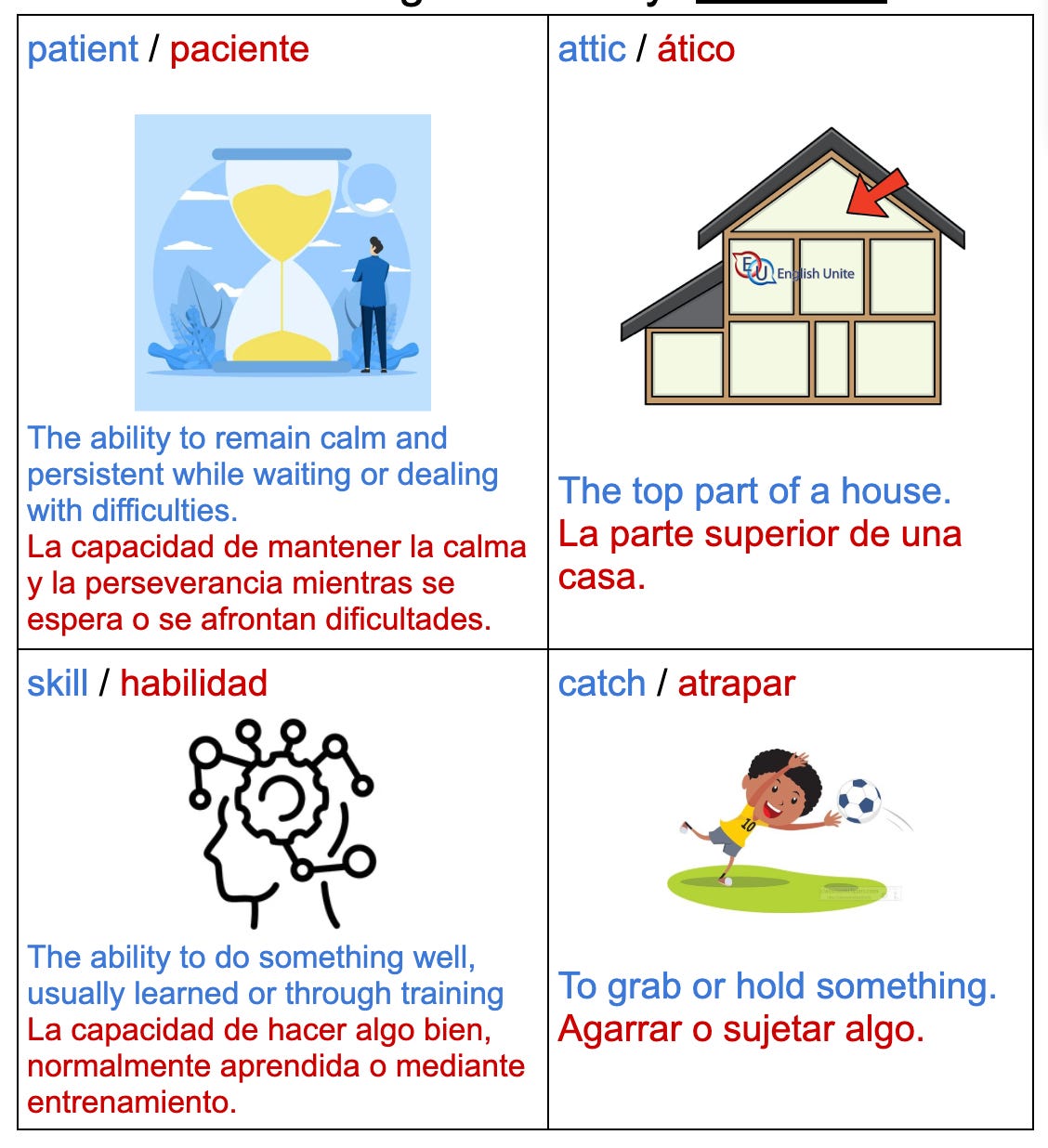
Prior to reading, I pull out a couple of crucial vocabulary words from the text to explicitly teach students. I typically try to select two cognates and two that are not cognates. Using cognates is very important for language learners because once they can hear the similarities between words in both languages independently, they will be able to recognize cognates automatically. At first, hearing the similarities between words like “patient” and “paciente” takes deliberate effort. Discussing and comparing the significance of words in Spanish exposes students to even more vocabulary, such as the word “wait’ which I used in my definition of “patient.” Conversely, looking directly at words like “catch” and “atrapar” which have no resemblance to each other gives students necessary background knowledge prior to reading. The words are presented to the students like this:
Multisyllable Reading and Spelling (10-15 minutes)
In addition to previewing the vocabulary with students, I also have students read and spell multisyllabic words pulled from the text prior to reading, in keeping with the procedures of my linguistic phonics program. This student had done those activities on a prior day and I didn’t capture it on video.
Read, Read Back, Read Again with Visualizing and Verbalizing (15-20 minutes)
For emergent bilingual students, I present the text in digestible chunks. I have adapted this text from my linguistic phonics program, breaking it up and adjusting some of the phrasing to make it more accessible for non-native speakers. For students with no English yet, I typically go sentence by sentence, pausing after each sentence to examine each word in the sentence closely and discuss its significance in Spanish. Next, I model fluent reading, reading the sentence for students. After, they read it again, aiming for correct pronunciation and fluency. Lastly, I use the illustrations which I added, which are covered while students read.
The inspiration for this component came from Lindamood-Bell’s Visualizing and Verbalizing Program, which I have seen students of all backgrounds have immense success with. I use aspects of this program when discussing text with students, having them first predict and explain in Spanish what they expect to see in the illustration and then checking the image to confirm their comprehension, as opposed to using the picture as a crutch to help them make guesses. Not only does this practice help students to comprehend the text word by word, but it also boosts their confidence when the illustration matches their visualization.
Summarizing (15 minutes)
This component may be the most crucial. After reading we answer basic questions about what occurred in the text orally in Spanish, while translating each thought into English. This allows me to check for comprehension and refresh students’ understanding of the meaning of certain words in English. For example, this student forgot that “catch” means “atrapar,” first guessing that “like” means “atrapar” because it was another verb in the same sentence. I am able to remind her of this while translating together, and then apply this vocabulary word again when she writes it herself. Summarizing also helps students of any language background to learn the difference between key and extraneous information, formulate strong, concise sentences, and apply proper grammar while writing.
 | A guest post by
|
You are a master teacher. These students are so lucky.
What a robust sequence! Thank you for sharing!