Data Deep Dive: Did I Avoid the Summer Slide?


All teachers know about the dreaded “Summer Slide.” It haunts all of us. The Summer Slide refers to the concept that our students leave school for 3 months over the summer, and upon their return, their academic skills and knowledge have regressed.
As an interventionist, I have seen this phenomenon play out time and again. It can be especially detrimental to struggling students because they end their school year behind their peers and begin their school year even further behind. The accumulation of the gap directly feeds into the ongoing achievement gap.
This past school year, I started using EBLI with my intervention students. It has transformed my instruction, and my student data has never been better. Students made accelerated gains and exited interventions more quickly than they ever have before.
This summer, I wondered about the Summer Slide. Would the progress my students made during the school year stick after a long summer away? How would these EBLI students compare to previous intervention students?
I decided to dig into this year’s beginning-of-the-year data, and I was pleasantly surprised. 79% of my intervention students from last year (22 out of 28) no longer qualify for Tier 3 Intervention, meaning that they are higher than the well-below benchmark. Many of them even reached the benchmark for specific subskills, and several will not need ANY interventions this Fall.
While I do believe that with even more consistent practice, a greater portion of these students will experience higher levels of fluency, I am encouraged that the students in my intervention groups are starting to experience enduring progress and success. EBLI instruction has not just given them the skill sets they need to become successful, but those skills are now a part of their forever learning. They can not be unlearned, and those children have a better leg to stand on as we move forward.
Here is a sampling of beginning of the year data from students I worked with:
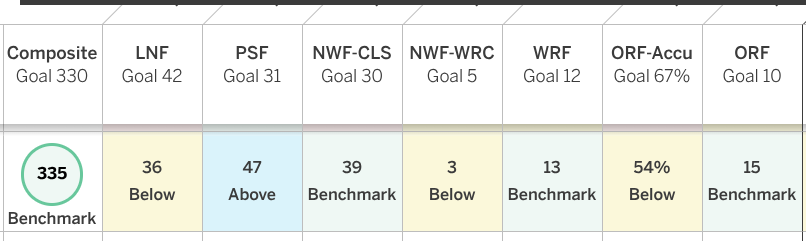
This incoming first grader was in intervention for about 4-5 weeks in kindergarten before he exited intervention. This student needs to work on continuous blending and learning the rest of the code, so that he can become more accurate and read with understanding. Students in kindergarten do not take the ORF assessment at the end of the year, so this was his first attempt at reading an ORF passage. This student will join our “Walk to Read” model in first grade this year. We designed this model at our school to allow students to receive the layers of support they need. In comparing his data to his grade level peers, he will most likely start by receiving Tier 1 instruction tailored to working on continuous blending while still learning more of the code. He will also receive an additional Tier 2 support. At this time, he will not need Tier 3 intensive support.
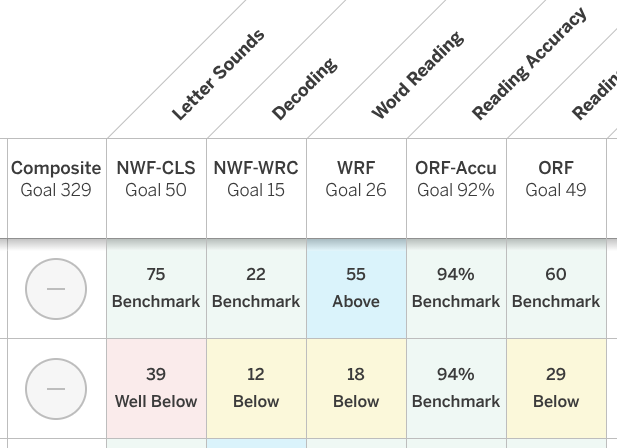
The student in the 2nd row was in intervention in 1st grade. Although her data is not where it should be, she did not attend kindergarten, so she was tasked with making up 2 years' worth of learning last year. She is now able to read an ORF passage and has attained an adequate level of accuracy. In comparing her data to where she left off last year, her accuracy on the ORF passage increased from 76% to 94%. She also improved her words read per minute from 19 to 29. She will still be in intervention, but she is starting from a much better place than she was last year. This student will also be a part of our “walk to read” model that we are extending into second grade this year. This will allow her to continue to receive several layers of tiered support.
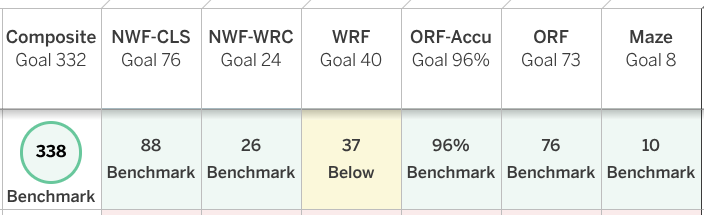
This incoming third-grader exited intervention at the end of last school year. While this student has maintained her progress from the end of the year to the beginning of the year, the most notable improvement was in her Maze score. At the end of the year she scored a 3.5 which was below benchmark standards, and now she is at the benchmark standard. This positive growth demonstrates that she is reading with high accuracy and comprehension. She has maintained her reading skills and will be able to access grade-level material alongside her classmates.
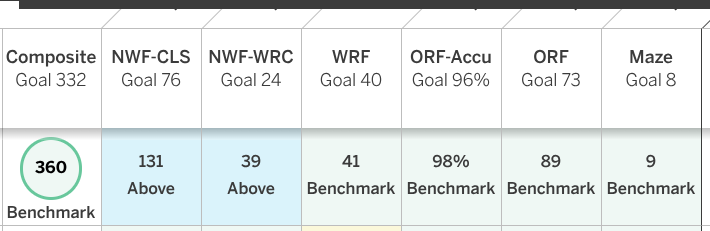
This is a 3rd grade student who exited interventions last year after about 5 weeks. He continues to make progress. This student’s scores are comparable to his end of the year benchmark, except for his WPM. This is an area that he can work on with classroom instruction, so he will not be receiving any interventions this Fall.
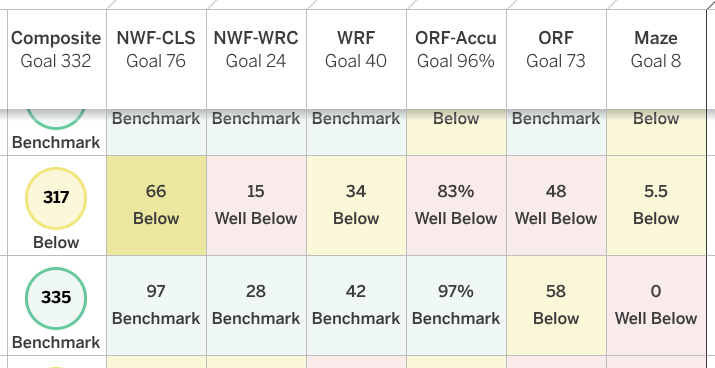
The student in the bottom row exited intervention midyear last year. He is now in 3rd grade and has continued to maintain his accuracy. After comparing this student’s end of the year scores to his current scores, the only area that did not remain consistent was the WPM. At the end of the year, the student was reading 117 words per minute. With fluency practice, we believe this child will be able to increase his rate while maintaining his accuracy. This was the first time that the student took the MAZE assessment, and reading for understanding will continue to be an area to work on this year. This student will not be receiving interventions this Fall.
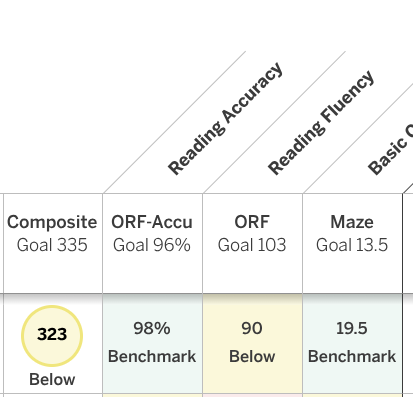
This is a current 5th-grade student. He received interventions from January until April last year. Although his composite is not at the benchmark yet, he has maintained accuracy and comprehension. There was a drop in WPM from the end of the year, but this student can continue to work on his fluency within tier 1 and 2 support. He will not need a tier 3 intervention this Fall.
Although there is definite room for improvement in the data, one trend was clear. Not only did students retain much of the progress they made last year, but they were also able to remain accurate in their oral reading. As a result, all of them are starting the year in a much better place than a year ago. The Summer Slide did not seem to have as much of an impact on these students as I have seen in the past. While there is plenty of work ahead of us, I am encouraged that the learning did, in fact, stick. In past years, this would not have been the case. I believe the EBLI instruction that they received last school year has directly impacted the skills these students were able to maintain. These students have spent most of their schooling years behind. Imagine where they could go now!
 | A guest post by
|
This is great, Elana! I love the examples you shared. We aren’t there yet as we start school tomorrow, but I have also been wondering how the summer slide will play out this year compared to last. I can’t wait to hear more about your Walk to Read model!