How Releasing Writers Completely Changed My Teaching


In this piece, 3rd grade teacher Olivia Eastwood reflects on how Releasing Writers (formerly ThinkSRSD) has transformed how she teaches writing and how her students write after she adopted it this year. If you’d like to see examples of what Releasing Writers looks like in Olivia’s classroom, you can view them here: Planning, Gist Statements, Feedback and Exemplars.
From Chaos to Consistency
Before Releasing Writers: When we wrote, we used the curriculum organizers, which were different every single time. This meant learning a new system with every new writing assignment.
With Releasing Writers: Now, we have one graphic organizer/framework that we use for everything.
Why this matters: This change has significantly reduced the cognitive load on kids that usually comes with writing. This consistency also allows kids to translate the skills into any writing task, in any subject. Instead of each graphic organizer and process being specific to the prompt, they are general, so students are repeating the process over and over, internalizing the process and using them in any setting.


From Dependence to Independence
Before Releasing Writers: I used to hear: “I don’t know what to do next” or “I’m stuck” all of the time. Writing can be one of the most cognitively challenging tasks for students. Between mechanics, syntax, idea production, organization, vocabulary, and the many other pieces involved in writing, when there is no consistent process or framework, students got even more overwhelmed.
With Releasing Writers: Students have internalized their next steps (or know exactly where to look if they can’t find it).The process is the same every time. They have models to use, and acronyms to pull from that reduce cognitive load. The framework is something students can create independently in a notebook, on the side of a paper, or on scrap paper. This means they are not relying on a teacher or a worksheet to tell them their next steps, but instead can pull everything from their own brain.
Why this matters: Students own their work. They use models to push themselves, they can navigate the steps of the framework independently, and setting goals and scoring themselves forces them to independently improve their work each week.
Now, I don’t have a sea of hands waiting for help- not only is it less overwhelming for the students, but it is for me too! Self talk also helps students feeling stuck persevere.
Hating Writing to Loving it
Before Releasing Writers: Writing used to be both mine and my students least favorite part of the day. I was trying to implement every strategy I could find (organizers, sentence level work, checklists, rubrics, countless grammar pages, ect), but nothing was really working. Writing is arguably the hardest thing my students do all day, and it didn’t help that I felt it was my weakest subject to teach. No one wants to do something that feels like such a difficult task.
With Releasing Writers: Students cheer “yes!” when I announce we are doing writing. Students who previously despised this time ask me every morning “are we doing writing?”, and it has quickly become my favorite subject to teach.
Why this matters: Being able to write well is something that not everyone can do. It is a huge test of synthesizing all literacy skills. It requires students to retrieve spelling, organize grammar, and express deep comprehension of different subjects all at the exact same time. Ultimately, writing is how our students will advocate for themselves, share their ideas, and make their voices heard. Writing is the way students communicate and a skill they will need throughout their life. Building this strong foundation in writing enables students to have critical thinking skills and share them with the world.
Based on teacher assumptions to evidence-based
Before Releasing Writers: I used to use various books, ideas from colleagues, or curriculum pieces, many of which claimed to be research or evidence-based. I eventually realized that much of it wasn’t and was just what teachers felt was the right way to teach writing.
With Releasing Writers: I am confident that what I am teaching is rooted in research- and I can see it working! If you want to check out some of the evidence base behind Releasing Writers, you can see it here. Releasing Writers is also easy to implement and has proven implementation science behind it.
Why This Matters: Releasing Writers is backed by more than two decades of research. It is proven to work, and takes the guesswork out of it for teachers. These studies have been done across different grades, settings, and writing assignments, which makes the research easy to trust. I felt confident that I was implementing something that had a potentially huge positive impact on my students.
Teacher-driven to Student-driven
Before Releasing Writers: I would create different rubrics for every single assignment, and everyone would work on the same thing. There was very little buy-in, and students didn’t really understand the purpose of a rubric. Students weren’t getting meaningful feedback and the rubrics certainly were not improving their writing.
With Releasing Writers: One step of the writing process with Releasing Writers is the way students are given an opportunity to score themselves with a consistent rubric each week, and then set a goal for the following week. When I first heard about this step, I didn’t think much of it, and honestly didn’t think my students would be mature enough to handle it. Instead, I quickly realized that this was one of the most meaningful pieces of the writing process. Setting goals naturally differentiates things for students - one student might be working on handwriting, another student on vocabulary, and another on organizing their writing.
Why This Matters: Because students are setting their own goals and not being told what to work on, they found so much more intrinsic motivation in writing. They are proud when they make improvement in their goals and can highlight that in their writing and in their score.
Subjective to Objective
Before Releasing Writers: Grading writing was so difficult for me. Every rubric was different, I had no idea what each piece of the rubric actually looked like in practice, and felt like I was being so subjective in grading.
With Releasing Writers: My feedback is able to be specific, objective, and consistent week to week. Both students and I can track their progress across rubrics.
Why this matters: This makes it easier for me to discuss student’s writing and progress with them and with other adults who are part of their team. I also know that I am grading all students in a way that is fair and according to the same, explicit expectations.
Isolated to Integrated
Before Releasing Writers: I used to teach grammar skills and sentence level skills in isolation, with either various worksheets from our curriculum or other activities.
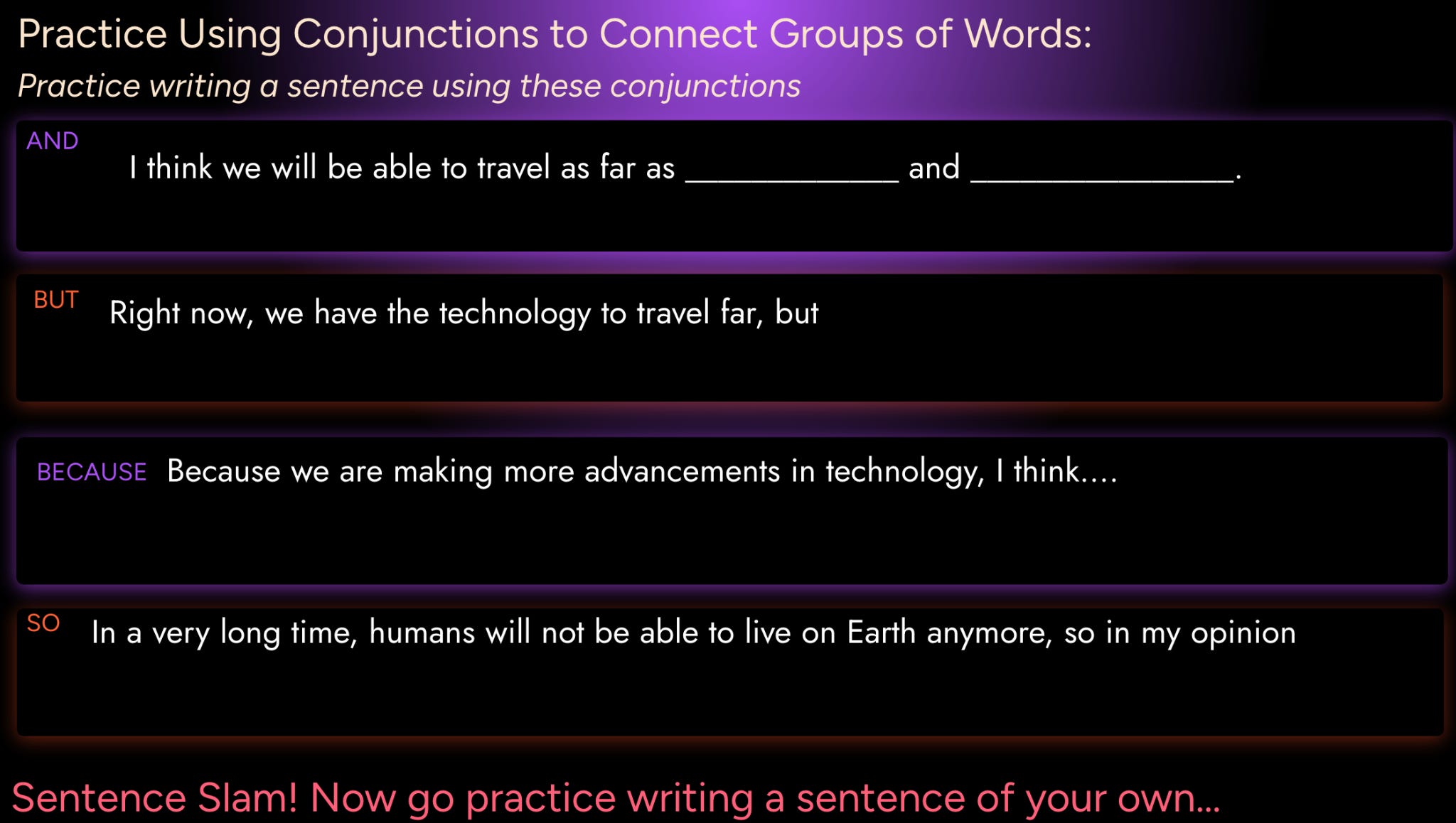
With Releasing Writers: It has become so much more meaningful to teach these skills integrated within writing. One activity we use for this is Sentence Slams.
As an example, we were practicing using conjunctions and also writing about what we thought the future of space travel would be like, as part of our astronomy unit. Instead of practicing conjunctions in isolation, without any real meaning, students created real examples they could use in their writing pieces.
Why This Matters: Teaching these grammar skills within writing gives them more meaning. Now students see how a skill actually connects to real writing, instead of practicing a random grammar rule in isolation with no clear use.
 | A guest post by
|
I love how you structured this piece Olivia! I'm feeling a little bummed because last year I was working whole class with a group of students 4 days a week so we did Releasing Writers and this year I only see my students 2x per week but this piece made me want to keep trying to figure out how to use Releasing Writers even if I have to get creative about how we do it in reading intervention.
Do you use Releasing Writers with all types of writing?