I Was Doing Fluency Wrong—Until I Made It About Knowledge
An Authentic Weekly Fluency Routine for Adolescent Readers


Fluency Isn’t the Problem—Empty Texts Are
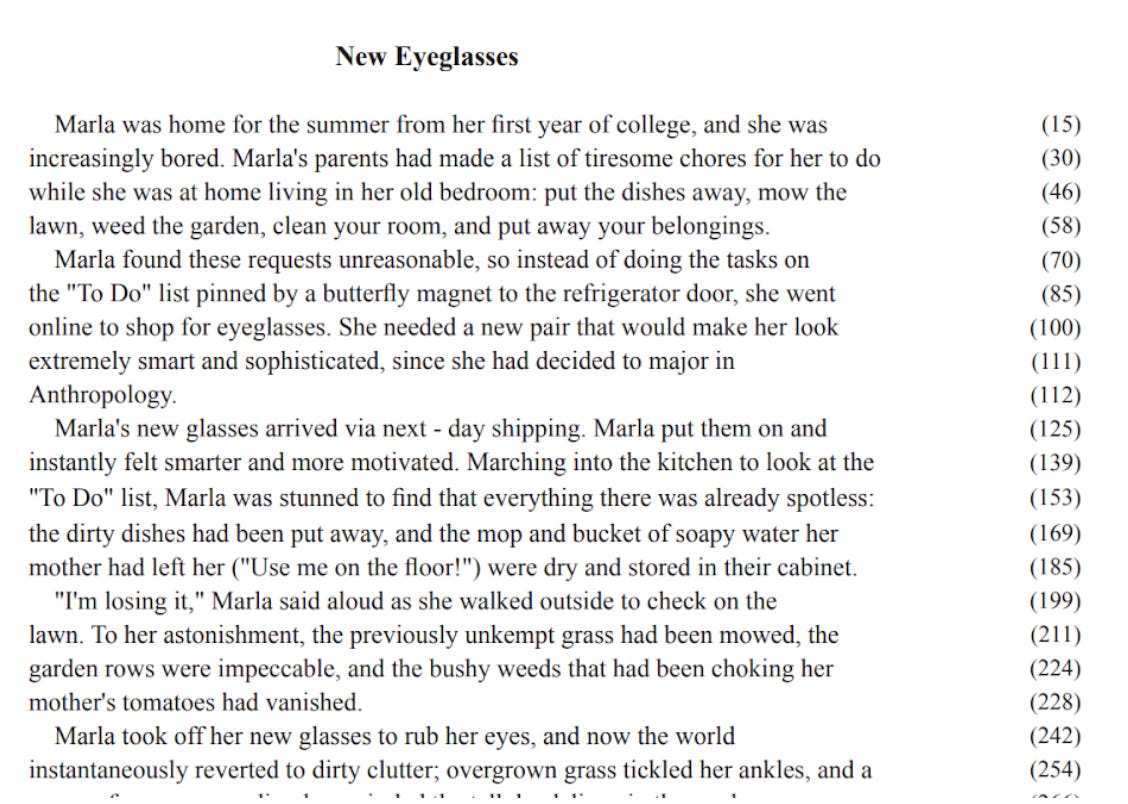
When I started working with striving adolescent readers, I knew that I wanted to incorporate an oral reading fluency routine that included repeated reading. Research suggests large effects for oral reading fluency instruction (≈0.95) and even larger effects for repeated reading (≈1.0–1.1; Hattie, 2011). Naturally, I began using the free Dibels 8th edition progress monitoring materials. These free passages provided a tidy, pre-formatted, grade-level text that my students could repeatedly read each week to measure reading speed and accuracy. However, I noticed fairly quickly (as did my students), that the content of the passages was often not very engaging, age-appropriate, or relevant to other learning. These passages are designed for data collection—not instruction. While they allowed for consistent measurement of rate and accuracy, they fell short in every other aspect of literacy: vocabulary, comprehension, and—most importantly—knowledge building. Narrative passages about a narrator’s fantastic memory or family pizza night don’t offer a lot of depth to build on instructionally. I tried, for a while, to incorporate additional skills practice with these passages, like doing some explicit vocabulary of tier 2 words in the passage or playing a comprehension game at the end of the week called “Find it.” And although these made the reading feel slightly more impactful, the root of the issue still existed.
One week, we read a passage about the history of radio. The significance of its entertainment and the evolution of it as a form of technology gave me far more instructional leverage. Instructionally, I played a clip of an old radio program, showed photos of families sitting around a large radio in their living rooms, and my students had rich discussions about the cultural shifts since the age of radio. A light bulb went off and I realized that repeated reading and fluency activities need not be devoid of content; if anything, they should be loaded with rich ideas and information!
Around the same time I began exploring the notion of teaching whole books in my high school Literacy Lab through novel studies. Years ago I read in the book Reading Reconsidered about the concept of using inside and outside the “bull’s eye” texts as a way to read literature and novels while building students’ knowledge through supplementary informational texts. If I were to teach a novel, perhaps I could utilize this daily fluency practice to expose students to complex informational texts that provide invaluable background knowledge to apply to our novel study. As a former high school English teacher, I wasted a lot of instructional time trying to shore up gaps in background knowledge during units through videos, pictures, TedTalks, whatever I could find. But this approach, particularly in a reading intervention class, allowed the text to be at the center of this knowledge building process while simultaneously supporting students’ decoding and oral reading fluency! By integrating multiple skills into what was once a lackluster fluency routine, my students began to engage in new ways and with newfound curiosity!
As a part of this process I discovered Intervention Central’s free Oral Reading Fluency Passage Generator where I can plug in any article or excerpt and it will not only format it into an ORF passage but will estimate its lexile and grade level, allowing me to monitor and adjust text complexity. Having this tool then allowed me to focus my time on what additional skills I could integrate into students’ daily oral reading fluency to accelerate their reading growth.
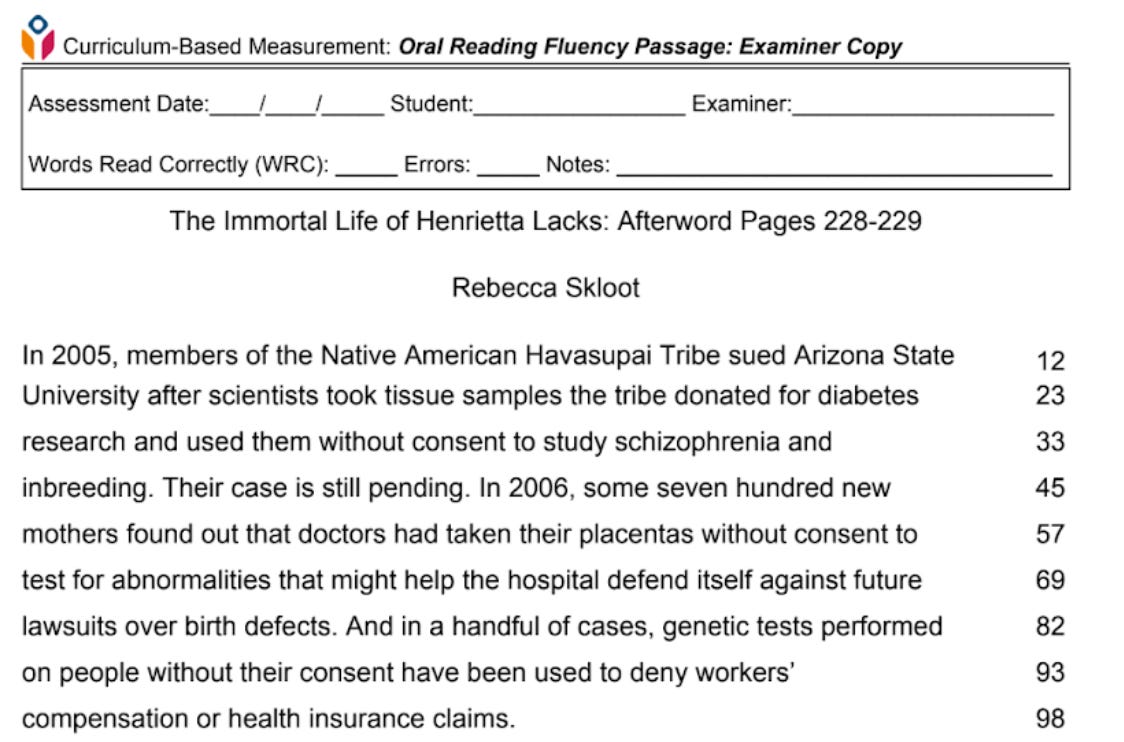
In the rest of this blog, I will share how my students use this fluency passage over the course of a week.
Multisyllabic Monday
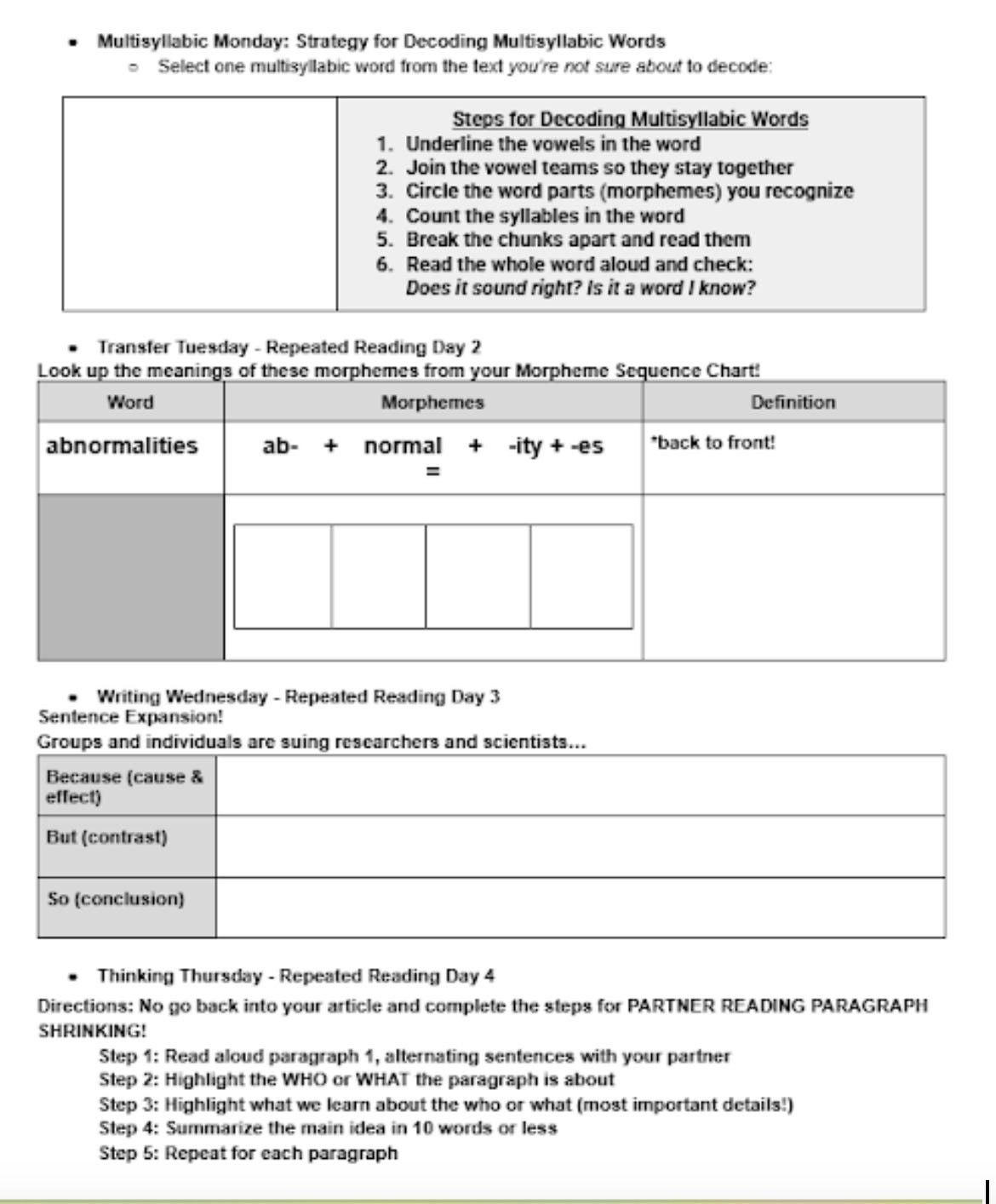
As a warm-up each day, I take students through active oral fluency activities such as echo reading, reciprocal reading, and choral reading to support decoding and prosody before partner reading for ORF. Anyone who has worked with adolescent readers knows many struggle to decode multisyllabic words. Once I had my weekly fluency passage sorted out, I knew there needed to be daily practice, with a heavy emphasis on a strategy for multisyllabic word reading. The first reading is when my students struggle the most with these unknown, longer words, so I decided to make Mondays “Multisyllabic Monday,” where students would select a word they either could not pronounce or misread and go through a series of steps to decode the word correctly. This has now become a staple in my class and has helped many of my students to achieve greater independence when encountering multisyllabic words in a text. I initially used a longer set of steps from IMSE’s Orton Gillingham Comprehensive Plus training, but have since paired this down to a simpler 6 step approach you’ll see in the materials below.
Transfer Tuesday
With “Multisyllabic Monday” officially incorporated and since we all love a little alliteration, my mind went to the other days of the week. Another component of my Lit Lab class is morphology instruction, and I’m always looking for more organic ways students can interact with words and their morphemes. Thus came “Transfer Tuesday,” a skills practice where students identify a vocabulary word, often tier 2 or 3 and multisyllabic that they can transfer knowledge of morphemes to interact with or define. My go-to activity after students do their repeated reading on Tuesdays is to create a word sum for an unfamiliar word in the text and then to use another form of the word in a sentence. This transfer creates meaningful opportunities for my students to flex their morphology knowledge beyond memorization of affixes and bases all while developing their vocabulary and deepening their understanding of the text.
Writing Wednesday
To continue the theme, Wednesdays became “Writing Wednesday,” with an emphasis on syntax and sentence expansion. Everything from ACES writing prompts based on the weekly fluency text to shorter, sentence-level focus through sentence expansion are on deck. One of the strongest activities has been The Writing Revolution’s “Because, But, So” statements and work with appositive phrases. Students are explicitly taught and given a model for how to write more complex sentences about what they read before practicing this skill themselves. With only doing this once a week we start small with lots of scaffolds and gradually release students to more independent practice of the skill. Once students have become proficient with one type of sentence structure we move to the next. Not only does this help them to become more mature writers, but it works inversely to support greater comprehension of similar complex sentence structure in high school level texts.
Thinking Thursday
Next, “Thinking Thursdays” allows me to ask students a thought-provoking annotating and discussion prompt to support comprehension and verbal reasoning skills. Lately, I’ve been using Partner Reading Paragraph Shrinking as our Thursday support activity. Students who before could plough through a text but any questioning about what they read revealed little to no comprehension are now forced to slow down and think about the meaning. My students really get a kick out of attempting to identify why I chose that article or information and how it will connect to our novel that week! Active reading strategies seem so simple, but for many of our struggling readers it is something they have never focused on because too much of their cognitive load and working memory is dedicated to decoding. Mind you, these are complex informational texts, often around topics students know nothing about, so the satisfaction of seeing things click for them where before they would have shut down is sheer magic.
Phonics Friday
Last, we moved to a four day school week this year so my routine ends with “Thinking Thursdays,” but Fridays are an amazing opportunity to focus on the reciprocal relationship between encoding and decoding. “Phonics Fridays” can look like anything from an encoding routine shared in a previous Substack, explicit instruction in spelling rules (like the drop or doubling rule), or word dictation and spelling practice of multisyllabic words from the text (notice a pattern of focusing on multisyllabic words almost every day?!). The other variation I’ve done on Fridays is “Find it Friday” where you play a comprehension retrieval game. The teacher flashes a comprehension question on the screen, students must silently read the question and find the answer in the text, then highlight the evidence that answers the question. First hand up with the correct highlight reads it aloud to the class and gets two points. Everyone else who had the correct answer highlighted gets 1 point. My athletic male students are sometimes the most pumped up for this activity! And yes, it’s a simple game, but reinforces looking back in the text and citing evidence to support answers, so I view it as a win.
Put it all together, and here is an example of what you get:
(We’re currently reading The Immortal Life of Henrietta Lacks in my high school Lit Lab)
Takeaways
By holding students accountable for more than simply saying the words, their literacy skills are being fostered well beyond oral reading fluency (although my students grow in that too)! These activities take roughly the first 15-20 minutes of each class period, leaving time for a rotation of encoding, vocabulary, morphology, novel reading and comprehension, writing, and discussion. This weekly fluency routine that I’ve developed has far exceeded anything I could have initially imagined for my students, and is one that I wish more struggling adolescent readers could receive. When we think innovatively with students and research at the forefront of our priorities, the possibilities for struggling adolescent readers are unbounded! If we can dedicate 15–20 minutes a day to fluency, we can also demand that those minutes build knowledge, language, and confidence—not just speed.
 | A guest post by
|
Faith, Excellent work!! I appreciate your sharing it with the world! I did a lot of this when I worked directly with students as their language therapist; my students predominantly had/have dyslexia and likely a bunch of them had DLD--I knew something was up with their oral language skills, but a diagnosis of DLD just did not exist at the time. Love that you are tackling 'whole/entire books' with your HS students. They need it! Carry on!
Ugh this is so fantastic Faith. Meaningful fluency practice like this should be the norm and you show us just how powerful it can be when done with intention. Love seeing your daily routines and how structured it is. Such a great lesson in doing less more deeply and the dividends that pays. Excellent point about students learning to read actively after YEARS of decoding commanding all of their cognitive attention, they need to learn what fluent reading actually feels like because they haven't often experienced it. I can't wait to implement Find It Fridays in my intervention class.