Know Your Destination: Backwards Design and Writing


During this past spring break, my family took a circuitous road trip through the Southwest, a journey filled with sights of canyons, petrified forests, and hoodoos. Planning and preparing for this trip was a challenge in and of itself but especially important was knowing where our arc through the Southwest would end and begin.
Considering where you are going is essential when planning any kind of journey. The same is true for the academic journey you may be preparing to lead students on throughout a course, a semester, a unit, or simply a lesson. Here at the beginning of a new school year or semester is a perfect time for some long-term planning to ensure you’re able to provide the best learning opportunities for your students.
One principle of instructional design that I have held to closely is that of backward design. Backward design essentially means beginning with the end in mind—considering the standards and instructional objectives for an entire lesson or unit and working backwards to plan assessments, activities, and tasks to ensure students are able to master those objectives.
One approach to using backward design in planning is to consider the standards-aligned culminating task for a particular lesson or unit, identify the knowledge and skills required for mastery, and then work backward, embedding and scaffolding those elements throughout the lesson or unit.
Strategic planning on the front end—especially that spans an entire unit and focuses on the end goals—is an effective way to ensure you are getting the most out of your instructional time with students and the academic tasks that they are completing. What follows is an example of how I have used backward design in my classroom to enrich my writing instruction and ensure my students are on target for success.
Planning the Journey
As a high school English teacher focused on growing students’ literacy skills and improving college readiness, teaching my students how to write extended responses and various types of essays is essential. Yet my students come to me with a variety of levels of readiness and stamina for these tasks. In order to prepare them to write a complete and effective essay, I have to work backwards from this goal and embed the necessary skills and content along the way to prepare them and build their writing stamina.
As I began this semester, I knew that my students need to be proficient in writing narrative, informational, and argumentative essays. These will be assessed via my district’s benchmark tests and on the state assessments. Not only this, but students especially need to understand argumentative writing, as this is a critical form in preparation for college and various careers.
Using the texts provided in my district’s high quality instructional materials (HMH’s Into Literature), I designed writing tasks to embed along the way that will systematically give them opportunities to develop and practice the various skills that they will bring together in a culminating informational or argumentative essay.
In my rhetoric unit, students dig into informative and rhetorically rich texts, such as Gandhi’s “Letter to Viceroy, Lord Irwin” and King’s “Letter from a Birmingham Jail” (though you could use any informational or rhetorical texts, speeches, or excerpts that are adequately complex and developmentally appropriate for your students). Using scaffolding and gradual release, we work our way through these texts, annotating key details and rhetorical devices and identifying central ideas, structural features, and elements of the author’s voice and style. Below I’ve embedded several examples of student work to illustrate these stops along the way.
Stops Along the Way
With each successive read of a text, I embed writing tasks. During the first read, we write gist statements of each significant section of the text. Usually, I begin by modeling this process both by thinking aloud about the key details of a particular section and demonstrating how to craft a gist statement. Then, my students work with partners or individually to review each section of the text and compose their gist statements.
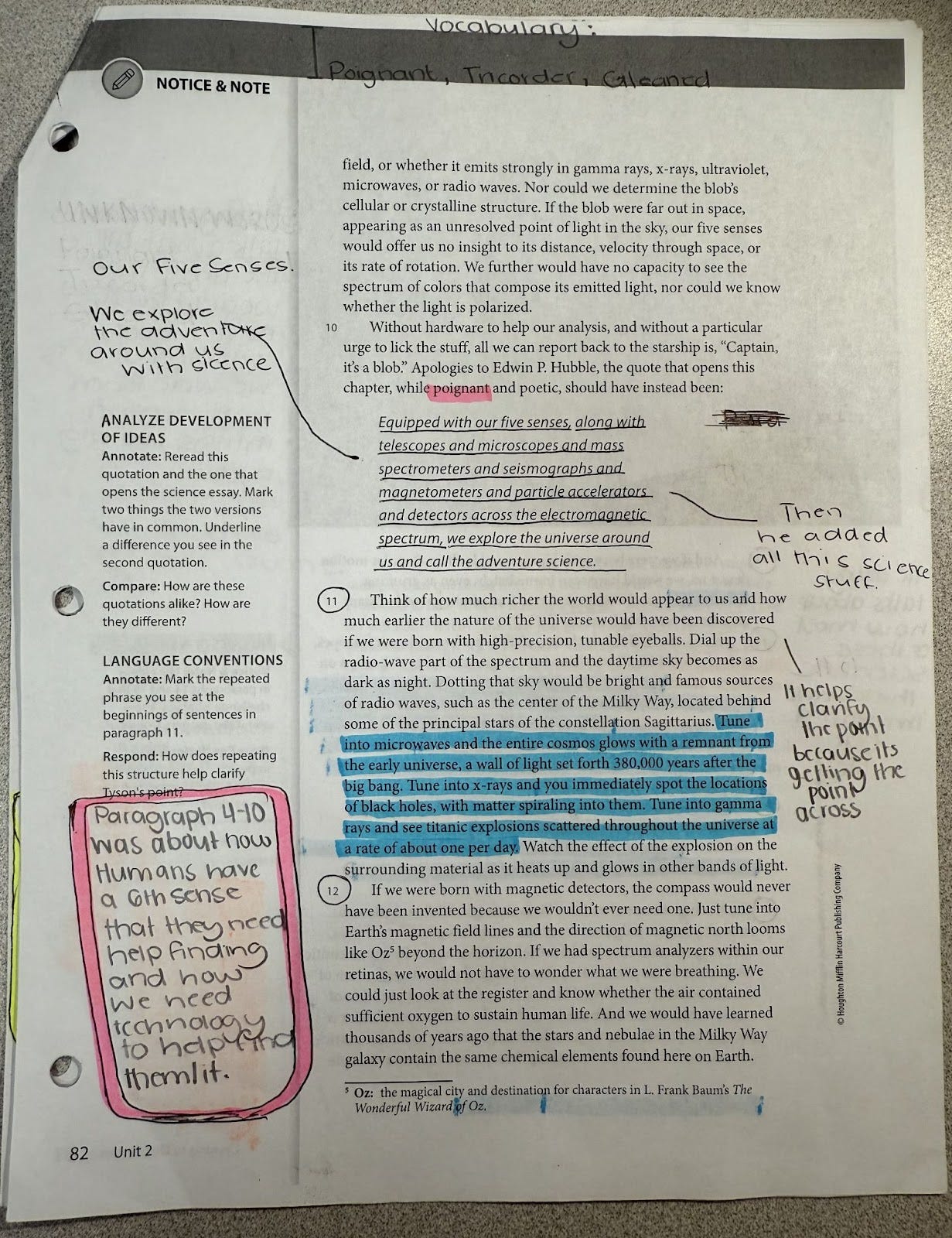
Following the gist statements, my students synthesize these individual sentences into an objective summary paragraph. Thus with the first read, students have wrestled with the meaning of the text and demonstrated their understanding through writing both in individual sentences and a summary paragraph.
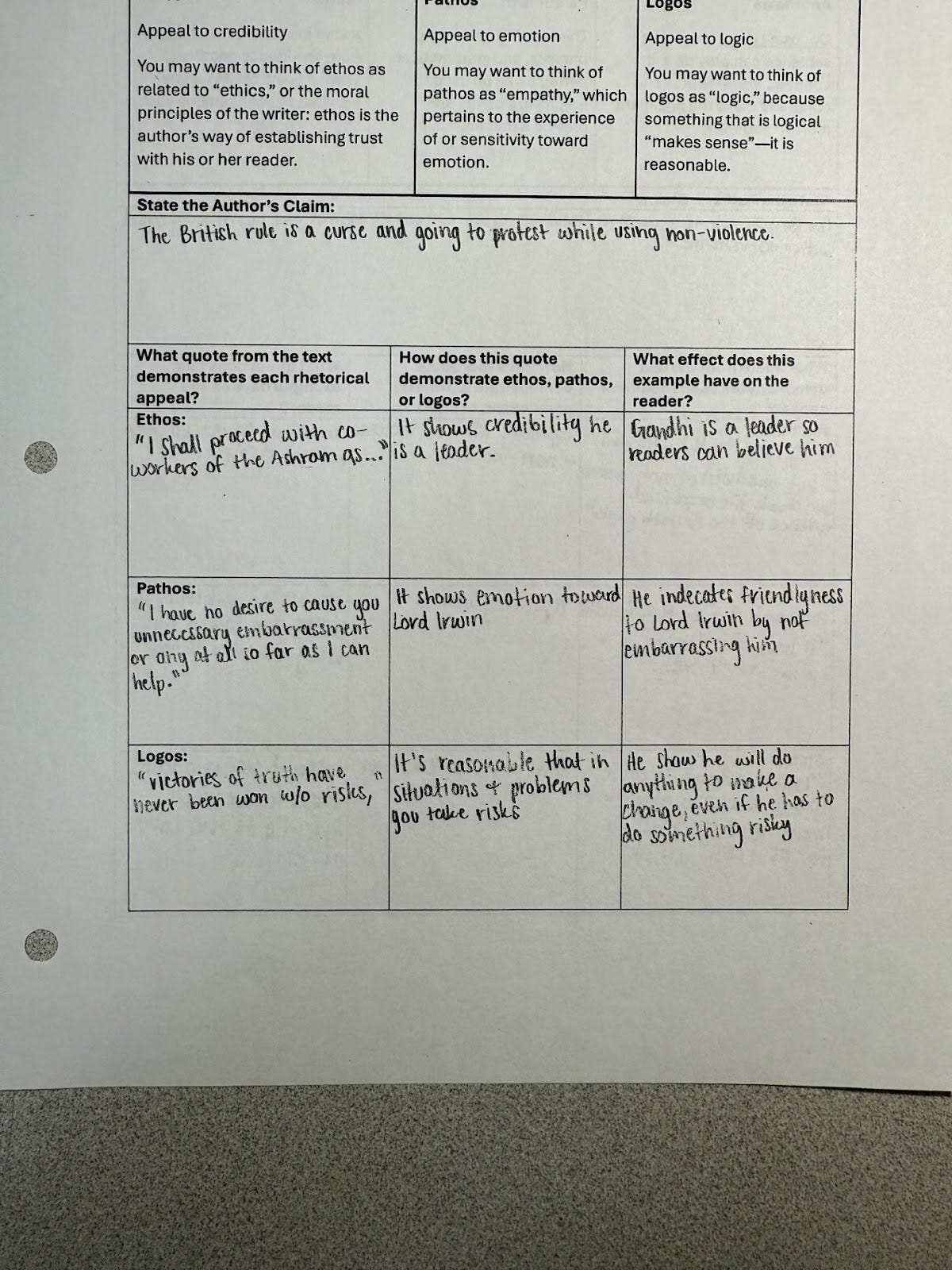
Next, after examining the texts for rhetorical appeals, they write brief explanations of how examples of each of the techniques function. Depending on the needs of the learners, I may scaffold these tasks to varying degrees with explicit modeling, think-write-pair-shares, detailed templates, or outlines.
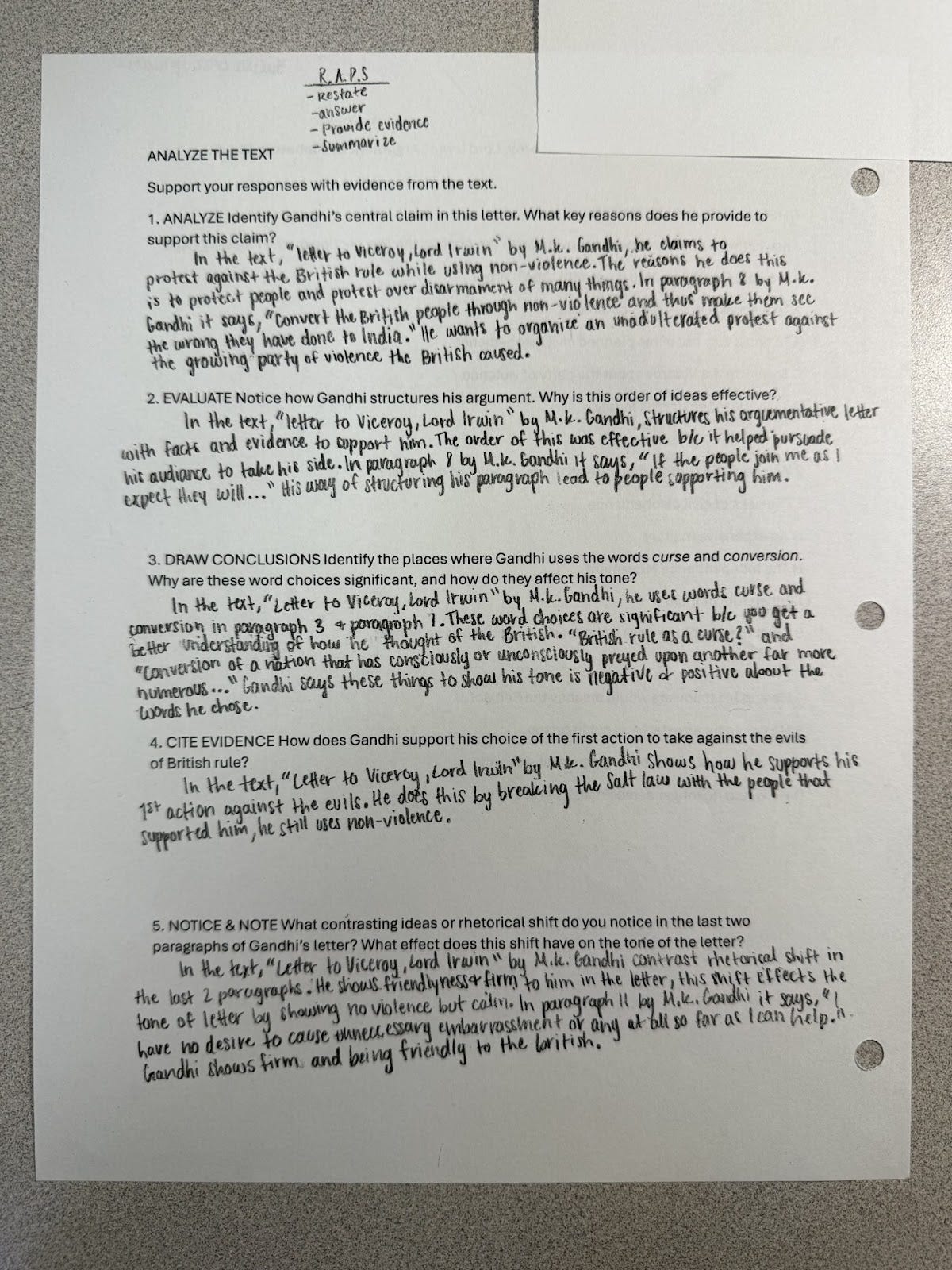
Next, I usually provide them with comprehension and analysis questions from the HQIM in addition to some text-based questions I have developed. For these questions, I require students to write robust answers in complete sentences that embed and interpret textual evidence in the form of direct quotes and paraphrases of the text with accurate citations.
Finally, drawing on the close reading and text-based questions, students will write some form of literary or textual analysis paragraph using a framework, such as a SOAPStone. This paragraph is essentially a form of practice for writing a body paragraph of an informative or argumentative essay, requiring students to have a clear topic sentence and appropriately embedded evidence.
Reaching the Destination
By the time students have worked through the texts and written at various levels—gist statements, summary paragraphs, rhetorical explanations, responses to questions, and an analysis paragraph—they are prepared for an essay or extended writing assignment.
While I am writing from my context in a high school English classroom, this approach and its scaffolded components could be adapted to shorter writing tasks and texts in a middle or even elementary classroom. The key is knowing where you want your students to go with their writing and planning out the discreet skills, strategies, and tasks along the way to get them there.
All along the tasks I provided were designed to be stops on a longer journey, one that ends with their confidence and skills built to tackle a culminating extended writing task. Utilizing this backward design process with multiple instructional cycles per semester ensures that my students complete my class with the writing skills they need to succeed down whatever road they choose to take.
 | A guest post by
|
“Following the gist statements, my students synthesize these individual sentences into an objective summary paragraph. Thus with the first read, students have wrestled with the meaning of the text and demonstrated their understanding through writing both in individual sentences and a summary paragraph.”
This is what I do.