Rethinking Phonemic Awareness: When Research and Classroom Practice Converge
By Kirsten Chansky

For several years, teaching my first graders ended with the same sinking feeling.
Despite strong phonics instruction and dedicated time for phonemic awareness, a small group of students consistently left my classroom unable to read. They knew their letter sounds and could complete phonological awareness tasks. They worked hard. Many had families providing additional support at home.
Still, decoding was difficult.
When I later stepped into roles as an instructional coach and as a Title I coordinator, I began to see the same pattern emerge across classrooms. Different teachers. Different materials. Different student groups. The pattern remained.
Students who could demonstrate phonological skills in isolation continued to struggle when those skills were expected to transfer to print. They could perform the tasks, but they could not use them to read. The pattern was too consistent to ignore.
It felt like we were doing everything right, but something essential was missing.
The common denominator was instructional design. This realization pushed me back into the research. What I found was enlightening…and unsettling.
Returning to the Research
I started with the Report of the National Reading Panel (2000), slowing down to examine what the panel actually identified as the most impactful elements of that instruction.
The report outlined several key features of effective phonemic awareness instruction, but most striking were the effect sizes tied to their findings.
First, the number of skills taught mattered. Programs that focused on one or two phonemic awareness skills produced substantially larger effects on reading outcomes than those that attempted to teach three or more skills simultaneously. For reading outcomes, the effect size for instruction targeting just two skills was 0.79, compared to 0.27 for those targeting multiple skills. At follow-up, that gap widened: 1.28 for focused instruction versus 0.23 when multiple skills were taught.
Depth appeared to matter more than breadth.
Second, integration with letters strengthened reading outcomes. Phonemic awareness instruction delivered with graphemes yielded an effect size of 0.67, compared to 0.38 without letters. At follow-up, the difference persisted (0.59 with letters, versus 0.36 without).
Anchoring phonemes to graphemes didn’t suddenly make it phonics. It made the skills transferable.
Third, dosage followed an inverted pattern. Programs providing between 10-18 hours of instruction produced the strongest outcomes (effect size 0.86). More extended programs—ranging from 20-75 hours—showed markedly smaller effects (0.31).
More time did not necessarily produce stronger results.
More recently, additional research has reinforced the same conclusions. Rehfeld and colleagues found that outcomes were nearly doubled when instruction began at the phoneme level rather than emphasizing larger phonological units first. Likewise, Nacollis et al. (2005) and Ukrainetz et al. (2011) found that skills such as syllable segmentation and onset-rime awareness are not prerequisites for phoneme-level work—and emphasizing them first can delay the development of the skills most directly tied to decoding. Indeed, the International Dyslexia Association echoed this in 2022, stating that, “phonological sensitivity instruction (with larger units such as rhyme, syllables, and onset-rime) is neither a prerequisite nor a causal factor in the development of phonemic awareness.”
The skills most critical for reading weren’t the final step. They were the instructional priority.
These findings were impossible to ignore.
Suddenly, patterns in my own classroom began to make sense. I had been implementing a 10-minute-per-day phonemic awareness program that covered multiple skills within a single lesson, often focused on larger sound units, excluded letters from instruction, and accumulated well over 20 hours across the school year.
On paper, I was doing what felt aligned with best practice. But when I compared that structure to what the research actually identified as most impactful: focused instruction on one or two skills, specifically blending and segmenting at the phoneme level, integrated with letters, delivered in a concentrated manner—the misalignment became clear.
The issue wasn’t effort.
It wasn’t commitment.
It wasn’t motivation.
The issue was instructional design.
And I needed to change it.
Designing Instruction Rooted in Research
Once I understood the gap between what I had been doing and what the research actually supported, my next instinct was simple: find something better.
I searched for instructional resources that reflected those core principles: focused work on phoneme blending and segmenting, integration with letters, careful sequencing, and clear transfer to print.
I didn’t find a single resource that fully aligned.
Instead, I found fragments. A routine here. A word list there. A practice activity that supported blending but didn’t connect to print. And everything still seemed to say: phonemic awareness happens in the dark—it never involves seeing letters.
So I began designing instruction myself.
At first, it was out of necessity. I created carefully sequenced lists of two, three, and four-phoneme words to blend and segment. I built lessons that connected phonemes directly to graphemes. And as I worked, I began to realize something larger. Even knowing exactly what I was looking for, access to research-based materials was limited. What about other teachers? What about their students?
A child should not have to win the instructional lottery to learn to read.
If this approach mattered for my students, it mattered for every student. So I kept designing.
I implemented early versions of the newly developed lessons alongside Pre-K, kindergarten, and intervention colleagues. During the 2024-2025 school year, we began to see meaningful shifts. Kindergarten students were reading—not just memorizing patterns, but really reading—earlier in the year. Blending became more automatic. High-frequency words were retained with less review. Skills transferred more consistently to connected text.
Those early results strengthened my resolve to finish the work.
I spent the summer refining the lessons into a complete instructional sequence. Researchers at the Center for Research and Reform in Education (CRRE) at Johns Hopkins University reviewed the program, now called Sounds of Success, and determined it met ESSA Tier 4 criteria. I collaborated with researchers there to launch a formal research plan to pursue higher levels of evidence.
In the fall of the 2025-2026 school year, Maine’s RSU 14 implemented Sounds of Success district-wide with full support of district leadership. Several additional districts across Maine expressed interest and six began piloting the program, contributing to a growing effort to align early literacy instruction with research.
What Happened When Instruction Aligned
Ultimately, the question was whether these instructional shifts would translate into improved student outcomes.
We closely monitored the progress of RSU 14 kindergarten students using DIBELS 8th Edition measures.
What we saw was not simply growth. It was a shift in trajectory.
At the beginning of the year, risk for reading difficulties was widespread.
On Nonsense Word Fluency—Correct Letter Sounds, 66% of students fell in the intensive range, the category associated with the highest risk for reading difficulties. By winter, that number had dropped to 13%. At the same time, the percentage of students meeting or exceeding benchmark rose from 14% to 78%.
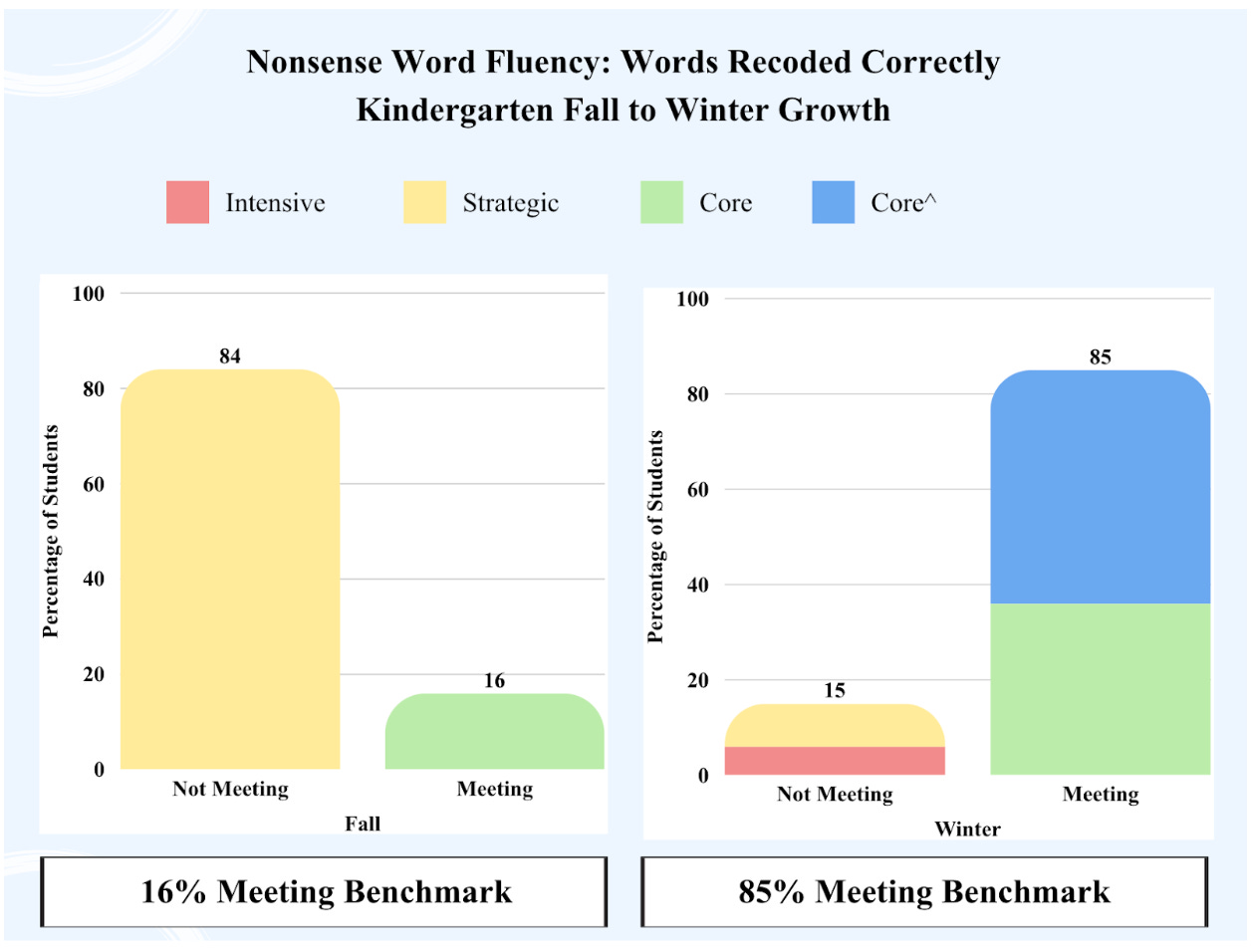
On Words Recoded Correctly, 84% of students were in the strategic range in the fall. By winter, that number dropped to 9%, and nearly half of students (49%) exceeded the benchmark.
Phoneme Segmentation Fluency showed perhaps the most striking shift. At the start of the year, 66% of students fell below benchmark. By winter, 100% of students had reached benchmark or higher, with 81% exceeding expectations.
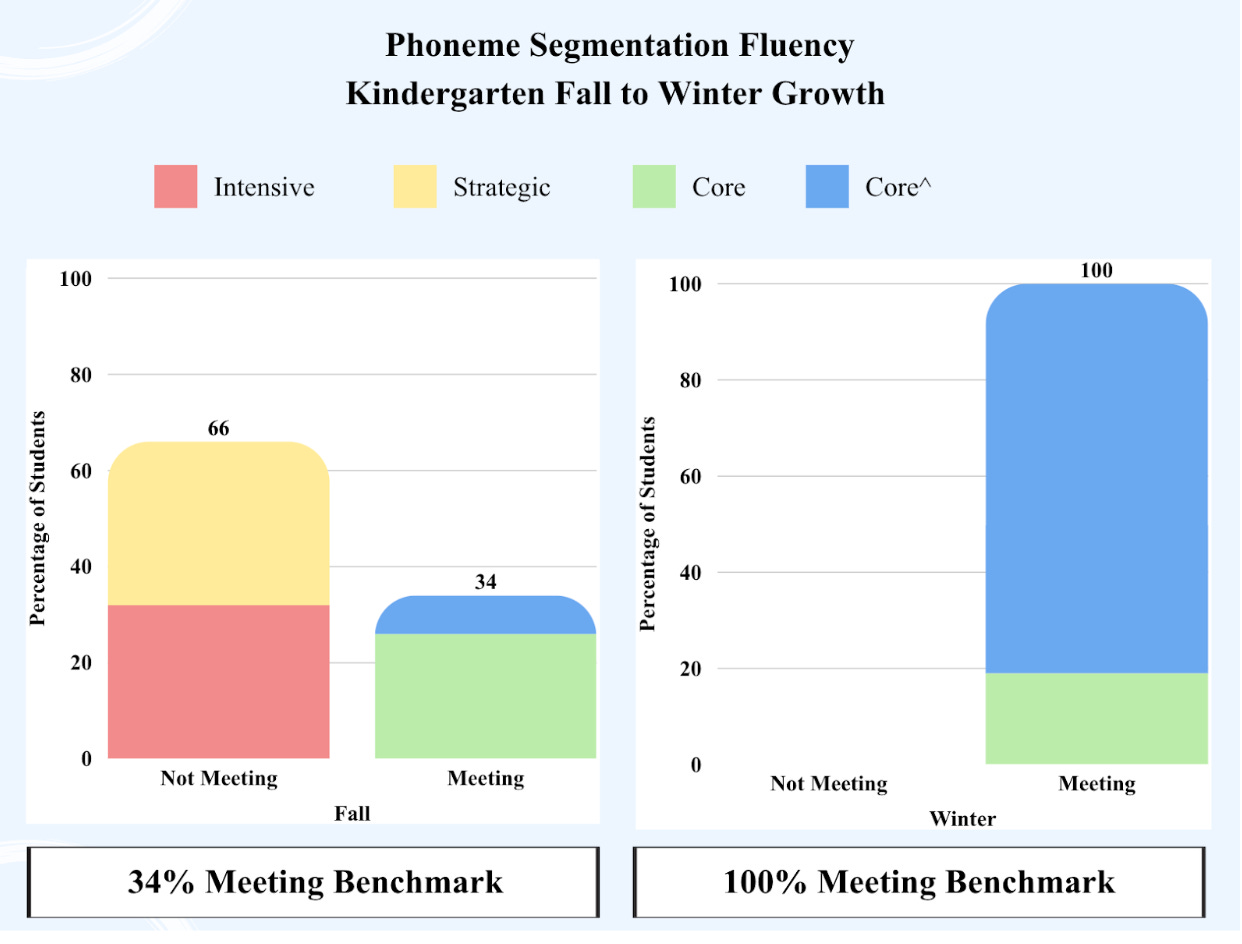
These changes matter because early performance on these measures is strongly predictive of later reading outcomes. Movement out of the intensive and strategic ranges reflects not just improvement, but reduced risk.
Classroom observations reinforced what the data suggested. Students were not just learning phonemic awareness tasks. They were developing the ability to use phonemic awareness to read.
For the first time in my career, I was watching foundational skills do exactly what they were supposed to do. They were unlocking reading.
Early Indicators Beyond Kindergarten
While kindergarten provided the clearest opportunity to examine direct effects, early indicators in first grade offered additional perspective.
This year’s first grade cohort included two classes of students who had previously received aligned phonemic awareness and phonics instruction the previous year. In the fall, 70% of students were meeting benchmark on DIBELS Oral Reading Fluency. By winter, that number had increased to 76%, approaching the commonly cited benchmark of 80% associated with strong core instruction.
In addition, i-Ready benchmarking showed these two classes made accelerated growth, with students reaching 99% and 100% of their annual typical growth targets by midyear.
Although no direct comparison group exists for this cohort, these outcomes suggest that when phonemic awareness develops as a transferable skill, students are better positioned to sustain growth as text demands increase.
These findings reinforce what the kindergarten data had already begun to show: when phonemic awareness supports decoding from the start, it strengthens the trajectory of reading development beyond the initial year of instruction.
What Changed in Practice
The difference was not more phonemic awareness. It was different phonemic awareness.
We narrowed instruction to two core skills: blending and segmenting phonemes. We more intentionally sequenced lessons. Students began with two-phoneme words, progressed to three, and then to four—increasing complexity as accuracy and automaticity developed.
We carefully selected the phonemes themselves. Early blending lessons emphasized continuous sounds, allowing students to sustain and connect phonemes through continuous blending. Early segmenting lessons used words with obstruent sounds that provided clearer acoustic boundaries, making individual phonemes easier to isolate. Over time, we expanded lessons to include all phonemes, supporting generalization as students’ proficiency grew.
From the very start, we connected phonemes to graphemes. Students were not blending and segmenting in isolation; they were learning to map sounds to letters. Phonemic awareness and phonics were not separated into distinct phases. Instead, letter-sound correspondences, phonemic awareness, and the application of those skills to print developed together. Students weren’t asked to wait to use these skills in reading and writing. They used them daily—and immediately.
Instruction was brief, daily, and systematic—approximately 5-10 minutes per day—designed to build efficiently and transfer quickly. Assessment guided pacing. Some students progressed rapidly; others received additional layers of support. The instructional structure remained consistent, but responsiveness was built in: additional auditory practice to strengthen automaticity, guided transfer lessons to support application to print, and clear response pathways to address specific error patterns.
Phonemic awareness was no longer something students practiced apart from reading. It became part of reading.
Students did not have to be told that blending and segmenting mattered for decoding. They experienced that connection directly. As they blended sounds, the corresponding letters appeared on the lesson slides. As they segmented words, they analyzed the same phonemes in print. Auditory practice was brief and purposeful, but most of their work anchored phonemes to graphemes. Students were not asked to imagine how these skills might apply to reading someday—they were using them in print every day.
Because of this, phonemic awareness and decoding did not develop separately. They developed in tandem, with each reinforcing the other. As students became more accurate and automatic with blending and segmenting, they were simultaneously becoming more accurate and automatic at reading and spelling. Application with letters was not a final step. It was the pathway through which the skills were developed–and the reason they transferred.
The research has long suggested that the design of phonemic awareness instruction matters. Which skills are prioritized, how they are sequenced, and how directly they connect to print all influence whether students develop reliable decoding abilities.
What changed for us was intentionally aligning instruction to reflect those principles. When blending and segmenting are taught explicitly, integrated with letters from the start, and practiced in ways that support transfer, phonemic awareness becomes what it was always meant to be: a tool for reading.
Every student deserves access to that kind of instruction.
And every teacher deserves access to the knowledge and tools that make it possible.
This is such great research. I can't wait for it to launch as well!
Those graphs are astonishing! Following the research, for the win! I've added my name to the list to be updated when Sounds of Success launches.