The Point Game


When it comes to struggling readers, one of the questions on the lips of educators and parents everywhere is, “but how do you get them to do ‘it’ on their own, without prompting, reminders or rewards? The second I stop reminding them, they slip into old habits, start to lose focus, and can’t seem to get it!”
The ‘it’ they’re referring to could be any number of crucial reading skills our students need to practice: from reading aloud to sounding out words while reading and writing, using correct letter formation or omitting previously inserted sounds in words when reading aloud. My answer to this question in almost every context and for almost every student is the same; “Use The Point Game!”
The Point Game is a cornerstone of Evidence-Based Literacy Instruction’s (EBLI) approach to motivation and behavior reinforcement during instruction, whether in the whole class setting or 1:1. The Point Game is simple. It appeals to our innately competitive nature by gamifying the instruction just a little bit to encourage focus and the acquisition of good habits.
Here’s how it works: the instructor assigns a number of points for executing a particular skill independently, accurately, or correctly. If the student can demonstrate a skill, they earn X number of points. The teacher records their points in a T chart labeled Teacher v. Student. The teacher gets points for things the student is not yet doing independently, such as keeping their eyes on the page while reading, reading aloud, or verbalizing sounds while sounding-out words and spelling. Students, especially young ones, don’t want to give their competitor (you) any points, so they are motivated to focus on a target skill to avoid allowing you to get any points. Plus, they feel rewarded when they execute a new skill and watch their points climb higher and higher
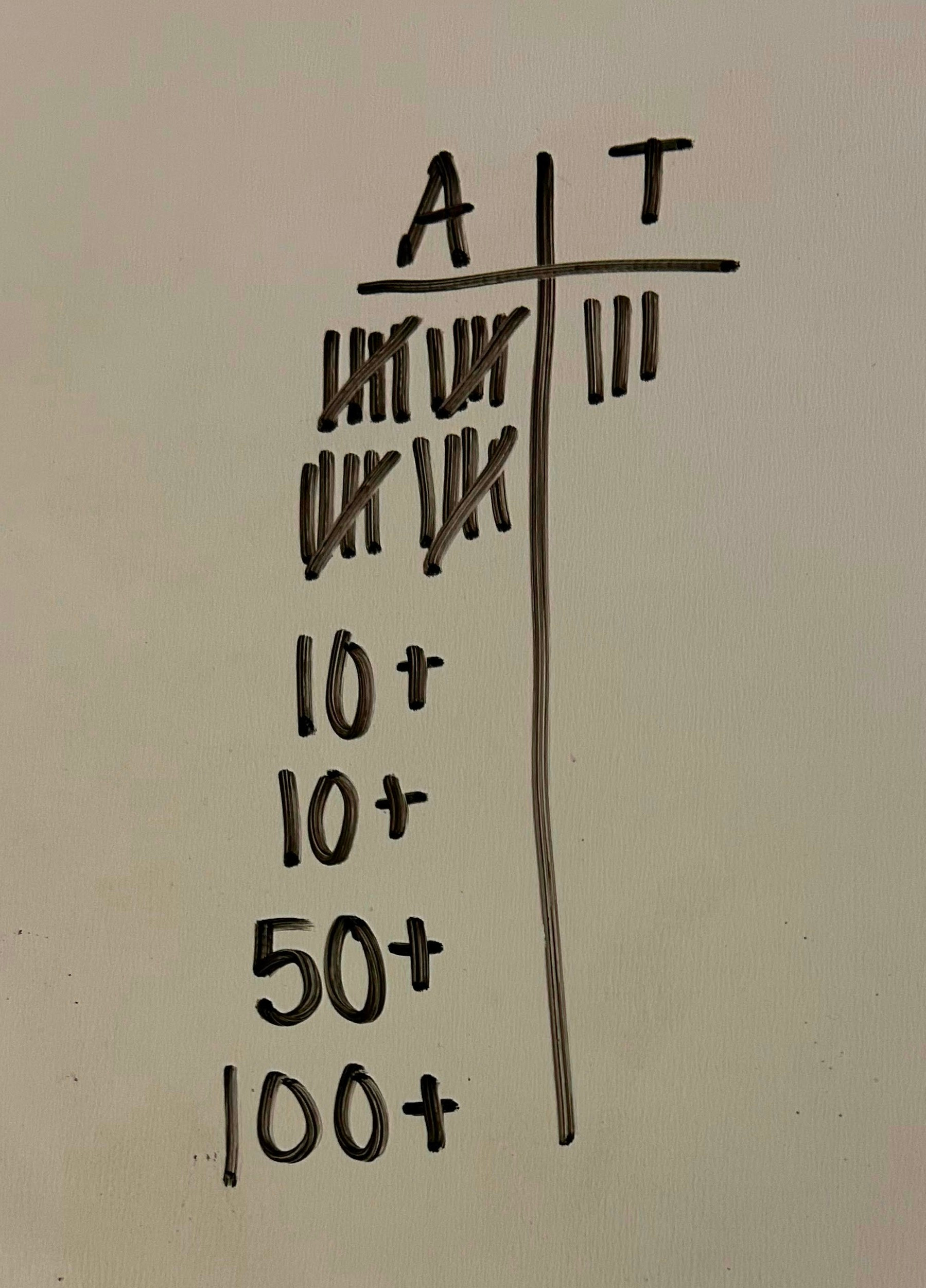
.There is quite a bit of nuance to successfully implementing the point game, so here are my pro-tips to maximize the impact of the point game with your readers.
Stick to the rules. Playing The Point Game presents an opportunity to build or break trust with students. Inevitably, you will be confronted with unexpected situations around earning points. In these moments, it is important to be honest about how many points you give for certain things and to demonstrate follow-through. If you say you will provide some points and don’t, students may start to resent this and The Point Game becomes less effective. Model ethical behavior and good sportsmanship through your words and actions!
Never take away points. Since we are committed to sticking to our own rules, this includes allowing students to keep the points they have earned. Taking away points is unnecessarily punitive, breaks trust with students, and complicates the mathematical function of The Point Game. Instead of taking away points, just give yourself points when the student does something that you want to reinforce against.
Take language proficiency and mathematical knowledge into account. When explaining the point game to students, be sure they understand how they earn points and how they will give you points. Including an example scenario is helpful. As a reading interventionist, I’m not always aware of my students’ mathematical abilities. There are benefits to using tally marks– students can clearly see their points stack up on the whiteboard as they take up more and more space. For older students, who may have difficulties with math, tally marks are more ambiguous than writing and adding regular numbers on the board. I often use a mix of both, adding tallies and then stacking up numbers below. At the end of the session, help students skip-count or add up points for a real-word math moment before heading out!
Go big or go home. Give students the chance to earn large sums of points for hard tasks. Breaking a guessing habit, learning to use an “ice skater” finger underneath words while reading when they realllllllyyyy want to tap their finger across the page, keeping one’s gaze fixed on a word while decoding instead of looking up at the teacher–these things are really difficult for students to implement, especially when it means fighting a strongly held habit. For these moments, award 50, 100, or even more points for doing something correctly. The promise of a big payoff helps students to focus and implement something well. To make the game as effective as possible, don’t offer large sums of points all the time because it becomes less impactful- sprinkle them in a few times each lesson when they get you the most bang for your buck.
Talk about effort and initiative. We are using The Point Game to push our students to do really difficult things. Use this as an opportunity to model a growth mindset, perseverance, and dedication to doing things the right way, not the easy way. When students are discouraged, we will do a quick affirmation where they tell themselves, “I can do it!” “I got this!” “I don’t need to guess!” or something else tailored to their needs, then I remind them, “You will earn 50 points if you have an ‘ice-skater finger’ the whole time. I know you can do it!” Once the obstacle has been overcome, “You are such a hard worker, I knew you could do it and look how many points you’ve earned!” Trust me, their smiles and pride will say it all.
Give yourself points. Many teachers fall into the trap of never giving themselves any points, allowing the students points to stack up and surrendering, “you beat me, I didn’t get a single one!” Over time, this will weaken the effectiveness of The Point Game because there is no real competition. Students need to feel some friction in order to feel continuing motivation to work for points. Plus, never earning any points may falsely create the sense that they are doing everything perfectly. There is always something that can be strengthened through The Point Game, be it letter formation or fighting the urge to fling out the first word that comes to mind when they see the first letter of a long word. Give yourself a point every time students behave a certain way to keep them striving and working hard.
Allow many opportunities for redemption. So, we’re giving ourselves points when students don’t do something that they are working towards, but we still want to be encouraging and build up students’ self esteem. When I get points for students doing something they shouldn’t, I clearly explain my rationale and then I give them a chance to try again, which might sound something like this; “I’m getting a point because you didn’t form the letter F the way we practiced, with a hook around then cross. If you can do it right in the next word, you can get 5 points.” This builds the stakes up and allows students to continue onward feeling that they have been successful.
Count them up at the end of each session. Wrap up each session by counting up the students points. This may be a moment to practice skip counting or multi-digit addition. It may be a moment to call out the hard work students did during the session, or remind them of something they learned and to practice those same strategies when reading independently. With many of my students, we keep track of what their personal record is for most points achieved. They feel so accomplished when they surpass their personal best, and when they set a new “school record!”
For particularly challenging or older students, add in an earned reward. If The Point Game isn’t motivating enough on its own, it may help to add in a simple opportunity to earn a small tangible reward. For some of my students, this means they may earn some Takis when they reach 100 points, or 250, depending on the child. Some of my students earn a 3 minute break to lay in the beanbag or play with legos when they reach a high point value. I ordinarily wouldn’t recommend using edible reinforcers, but in moderation and in conjunction with The Point Game, a little snack can bring about great results.
Using these tips when implementing The Point Game is sure to bring you success with learners of all ages. Let me know what this looks like with your students in the comments below!
 | A guest post by
|
The point game works! Try it, you'll like it!
The point game is simple and effective. Nicely described here. I use it in both my EBLI teaching and in my Reading Mastery group. Effective practices can and should be a part of any effective curriculum.