


We want to keep this blog and its content free for all readers. Help support our work by becoming a paid subscriber. Read more about our efforts to grow.
Last month, Indiana’s Secretary of Education, Katie Jenner, wrote an op-ed, declaring that “in 2026, nearly 90 percent of Indiana third grade students were reading proficiently.”
Sounds like cause for celebration, right?
Not so fast.
In the same year, only 42% of the same group of students passed the statewide ILEARN ELA assessment.
What’s going on?
Here’s the deal: In Indiana, 3rd graders take two literacy assessments: the IREAD, a foundational literacy assessment, and the ILEARN ELA, which measures grade-level ELA standards. In 2026, 88% of Indiana 3rd graders passed the IREAD. 42% passed the ILEARN.
I repeat: what’s going on? Why are nearly 90% of Indiana 3rd graders passing the IREAD, but only 42% are achieving proficiency on the ILEARN?
Before we attempt to answer this question, let’s take a look at the two assessments.
First, it’s worth noting that the IREAD was effectively developed in-house in the early 2010s by the Indiana Department of Education with select Indiana educators. The ILEARN, on the other hand, was developed in the late 2010s by American Institutes for Research (since acquired by Cambium Learning).
Conveniently, Indiana shares select questions from previous IREADs and ILEARNs in this Released Items Repository. I spent some time working through the 3rd grade questions myself, and I encourage you to do the same. I’ll share a few highlights of what I found below.
My first several IREAD questions involved minimal reading. I pressed the play button, and a voice instructed me to “find the word that has the same ending sound as ‘hard’” from a multiple choice list. All questions on the IREAD are multiple choice.
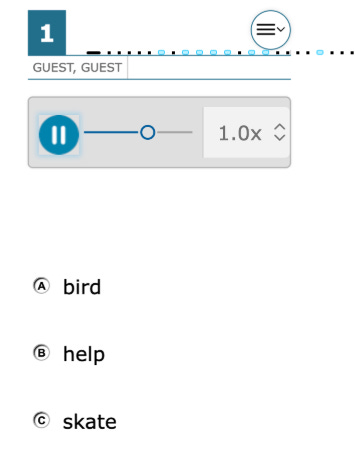
I was initially surprised by this question for three reasons. One, it seemed far too easy for 3rd graders. Two, I questioned whether it was assessing reading proficiency in a real way. Three, I wondered why students weren’t expected to read the instructions. At this point, I actually checked to confirm that I was viewing questions written for 3rd graders. I was.
On the other hand, my first ILEARN question presented me with a short passage about “Smithsonian Sleepovers” and three accompanying visuals.

The question itself is not particularly difficult. I didn’t need to read the passage to answer it. But I was struck by the cognitive demands of the passage. How many Indiana third graders have encountered “the Smithsonian?” Do they know what the Star-Spangled Banner refers to here? Are they clear that Discovery is the name of a space shuttle? There are so many different cultural and historical references jammed into this short passage; it’s easy to see how a 3rd grader might get confused by it. It’s also easy to see how a 3rd grader, who was lucky enough to visit Washington D.C. and various Smithsonian museums over his Spring Break, might have a leg up on a classmate who stayed home.
Over on IREAD, I’m asked to “find the word that has the same ending sound as ‘lake.’” Then, I encounter this question, the first one where I actually need to read the instructions.

Over on ILEARN, I’ve moved onto a longer passage, which is excerpted from a story called “The Case of the Alien Jewel Thief.” The story appears to take place in a world full of talking animals. Someone has stolen Mrs. Ladybug’s prize jewels, and the lizard detectives, Iggy and Sal, intend to solve the case. The passage begins in the middle of the conflict, with minimal background information provided.
I’m prompted to answer the following questions.
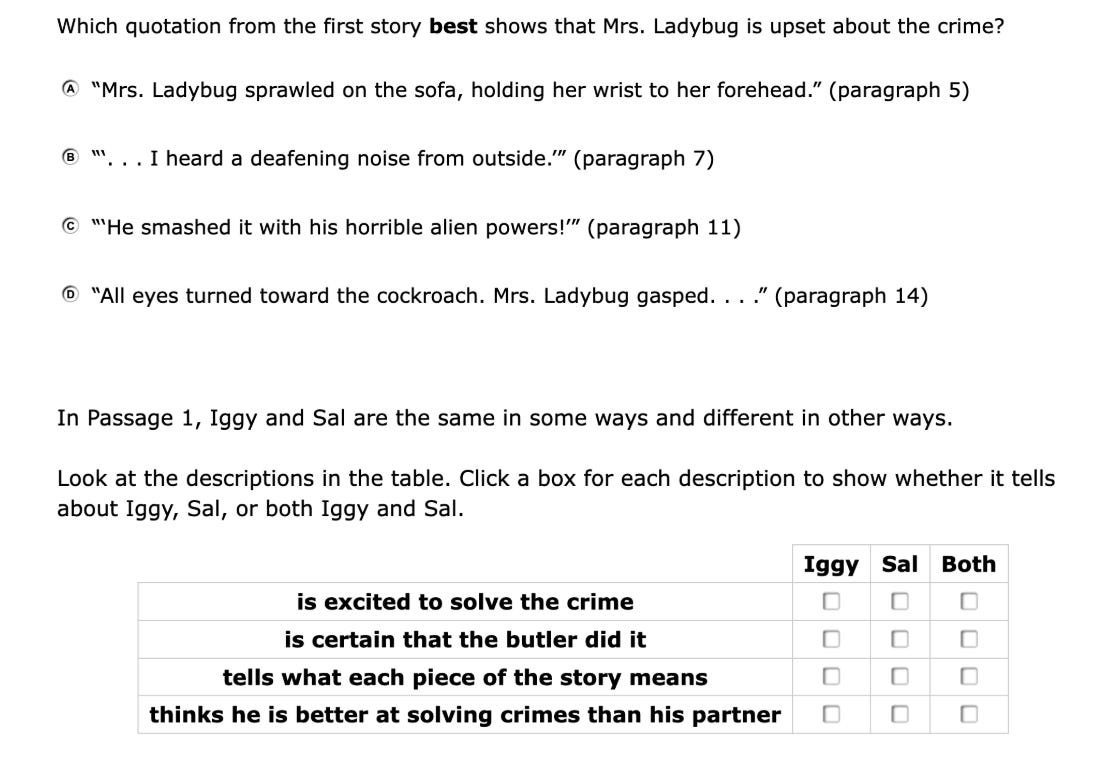
These are not easy questions. The first one requires careful close reading. The second one requires the reader to go back to the text and search for textual evidence for each statement.
Over on IREAD, I get two vocabulary questions, including this one. I’m pretty sure my 2 year old could answer it if I asked it orally (admittedly, she can’t read yet).

On ILEARN, I get two more dense, non-fiction passages, one about Jane Goodall and another about bees, before encountering a vocabulary question from the bee passage.

This question demands that the test taker know or can deduce from context the multiple meanings of the word “slip.” This sentence itself is challenging because, especially out of context, it might not be obvious that “thieves” and “guards” refer to bees.
Over on the IREAD, I finally encounter an actual reading passage.
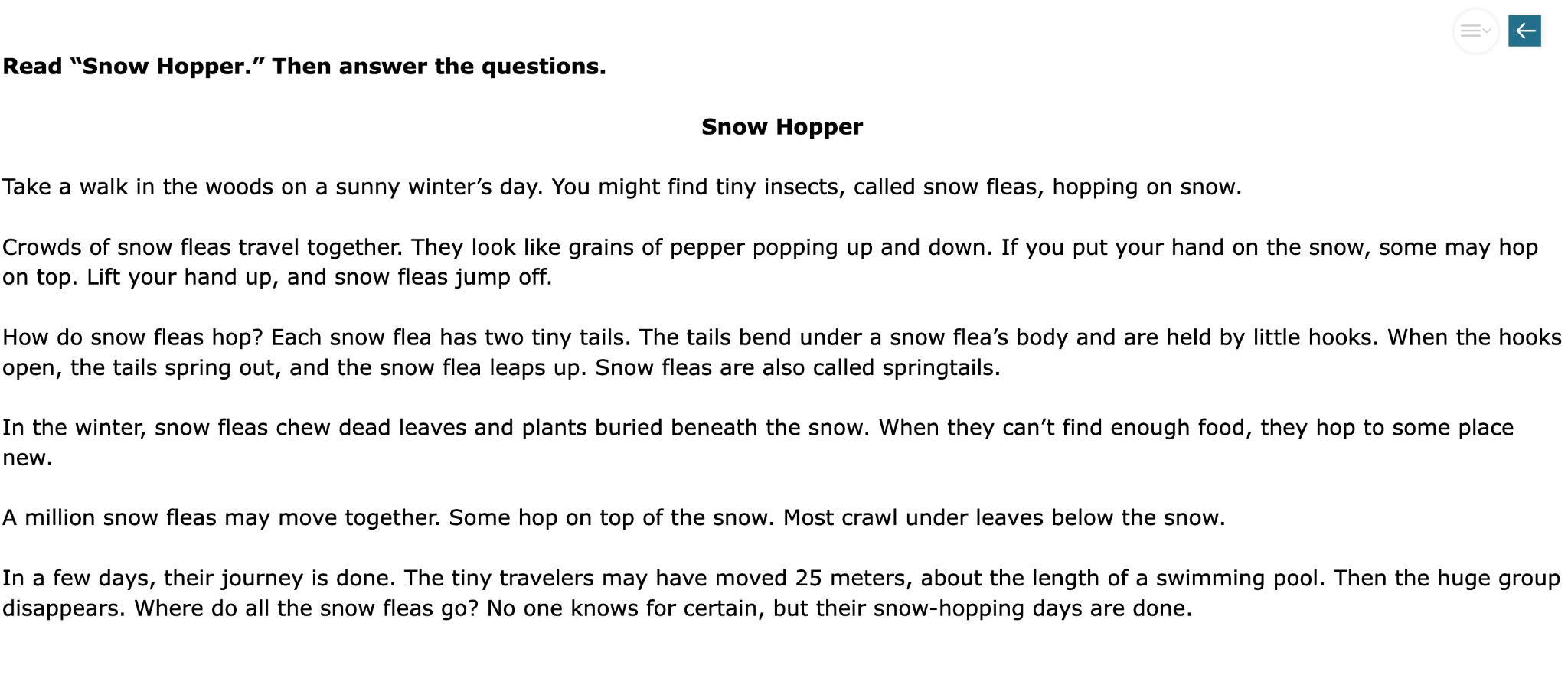

While this passage unlocks a new fear for me (snow fleas…), test takers don’t need to read it in order to answer the question. Notably, the passage is substantially shorter and uses simpler vocabulary than any of the ILEARN passages I encountered.
______
So, to return to the original question: why are nearly 90% of Indiana 3rd graders passing the IREAD, but only 42% are achieving proficiency on the ILEARN?
The answer is actually quite simple. Nearly 90% of Indiana 3rd graders pass the IREAD because it is a very easy test. Approximately 40% pass the ILEARN ELA because it is a hard test. Case closed.
So what should Indiana do? What can we learn from Indiana? I have a few thoughts:
Stop using the IREAD. The IREAD can identify the small percentage of Indiana 3rd graders who are functionally illiterate. That’s all it can do. It’s not diagnostic. It doesn’t screen for or identify particular reading deficits. There are free, less time-consuming tools that can get you more useful information. The IREAD is a waste of time and money. Indiana should stop using it.
If Indiana continues using the IREAD, state officials should stop making extraordinary claims about the results. There’s nothing wrong with celebrating progress. Indeed Indiana 3rd graders have nearly returned to pre-pandemic IREAD passage rates. This is good. But to equate passing the IREAD to 3rd grade reading proficiency is just absurd and dishonest. Indiana families and educators deserve honesty.
Don’t over-interpret ILEARN results either. I’m not sure if the ILEARN is too difficult for Indiana 3rd graders or not. I AM sure that it’s not a particularly fair test. In fact, I don’t think ANY state reading test is particularly fair.
The ILEARN, like other state reading tests, purports to measure student reading comprehension. In reality, it’s more a test of student background knowledge. Simply, students are going to do better on reading comprehension questions about content they’ve previously learned. A 3rd grader who has spent six weeks studying pollinators is probably going to have a much easier time reading a passage about bees than a student who studied astronomy instead. A student who visited the Smithsonian over Spring break is going to do better on a passage about the Smithsonian than the student who stayed home. Students are at the mercy of test writers here. Some years, they’ll probably get lucky and get tested on the content they studied. Other years, they’ll get unlucky and won’t encounter previously learned content.
State reading tests like the ILEARN should be built around content drawn from state science and social studies standards. Natalie Wexler has made this case before. After spending time analyzing ILEARN questions, I’m increasingly convinced that she’s right. Grounding these tests in state science and social studies standards would help level the playing field for students AND teachers alike. I understand that this change would require unprecedented amounts of coordination, funding, and experimentation, as Wexler details in her piece. But I think it’s a worthwhile, long-term goal.
Indiana is testing its students too much. I think state standardized testing is important. Even if the tests are flawed, they provide some information about student progress and knowledge. I do not want to abolish state tests like the ILEARN; I just want to make them better. However, Indiana is testing its third graders way too much.
Last year, Indiana third graders took three checkpoint ILEARN assessments in both ELA and Math. In the Spring, they took summative ILEARNs in ELA and Math. They also took the IREAD (if they didn’t pass it in 2nd grade). All of these assessments are untimed. Based on estimates I could find online, I expect that most 3rd graders are probably spending 8-12 hours taking these tests over the course of the year. Of course, this estimate doesn’t account for the time teachers spend preparing students for these assessments nor does it factor in time spent on other tests like iReady or MAP. To be clear, this over-testing phenomenon is not specific to Indiana. All across the country, we are sacrificing valuable instructional time to collect data that does not tell us very much. We should stop doing this.
I’ll end with this. I happened to tell a local colleague about my fascination with Indiana reading tests. It turns out that her cousin’s daughter is entering 3rd grade in Indiana this year and earned a perfect score on the IREAD in 2nd grade last year. This passing score means she won’t take the assessment again in 3rd grade. However, my colleague’s cousin questioned her daughter’s strong result because she thinks she actually struggles quite a bit with reading.
My colleague administered the DIBELS to learn more, finding that her composite score was below benchmark, with particular weaknesses in oral reading fluency and nonsense word fluency. The IREAD failed to detect any of these challenges. Her state’s Secretary of Education will count her as a proficient reader, but she is not.
I share this story because it reveals two huge problems with the IREAD. First, this student’s high IREAD score may deny her the extra, in-school support she needs and deserves. Second, more broadly, the IREAD is redefining and diminishing what it means to be a proficient reader. I don’t think the test was designed to do this, but that’s how state officials are currently using it. In doing so, they are lowering expectations for all Indiana students and teachers.
Super analysis that one rarely sees with the state mishmash of tests. I wonder what the relationship between IREAD and other standardized measures is?
This is simultaneously horrifying, fascinating, and not surprising.